Your legs carry you through every part of the day. Getting off a chair, climbing a step, walking to the kitchen. When those muscles stay strong, you feel steadier and more confident on your feet.
Building strength does not require a gym, a trainer, or anything expensive.
A handful of simple moves, done at home, can make a real difference to how you feel day to day. The NHS points to strength and balance exercise as one of the most effective ways to lower the risk of falls for older adults. That is a strong reason to start, however small.
Why strength matters for staying on your feet
A stumble on a loose rug or an uneven pavement does not always become a fall. Stronger legs give you a better chance of catching yourself in time.
Everyday tasks also feel less effortful when you have a little more muscle. Getting up from a low sofa, lifting a shopping bag, stepping off a kerb.
None of those things should feel like a lot.
If you are already thinking about how to prevent falls at home, building strength is the piece that works from the inside out.
The changes you make to your home reduce hazards. Strong legs help you deal with the hazards you cannot remove.
Before you start
Pick a time of day when you feel alert and not rushed. Morning after breakfast works well for many people, but choose what fits your routine.
Wear flat shoes or supportive trainers, never socks on a hard floor. Have a sturdy chair behind you or a wall within arm’s reach for balance.
Start with fewer repetitions than you think you need. A comfortable session you actually repeat is far more useful than an ambitious one that leaves you sore.
Rest days are not laziness. They are part of how muscles grow.
That is worth remembering on the days when doing nothing feels like falling behind.
Check with your GP before starting a new exercise routine, especially if you have heart problems, joint issues, or have had a fall recently.
Five moves to build everyday strength
You do not need all five at once. Pick two or three, get comfortable, then add more when you are ready.
1. Sit-to-stand (chair rises)
This is the most useful exercise you can do. Every time you stand up from a chair unaided, you are building the leg strength that keeps you independent.
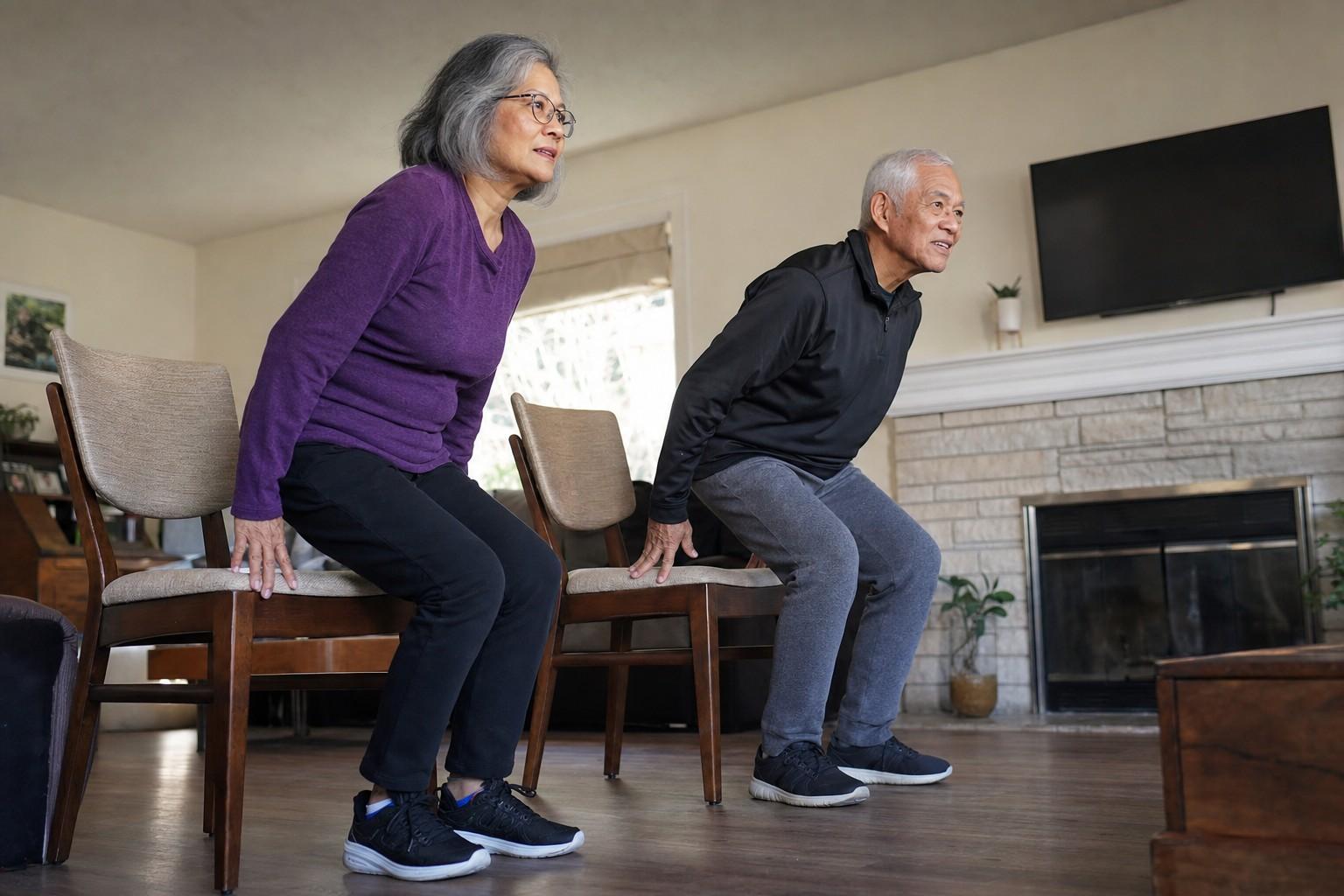
Sit toward the front of a firm chair, feet flat on the floor, roughly hip-width apart. Lean forward slightly, then push through your heels to stand. Lower back down slowly, landing gently rather than dropping.
Aim for 5 to 8 repetitions to start. Rest for a minute, then repeat.
To make it easier: use your hands on the armrests to help at first, then use them less as you grow stronger.
To make it harder: hold your arms crossed over your chest, or slow the lowering phase to a count of three.
2. Heel raises
Stand behind your chair, holding the back lightly for balance.
Rise slowly onto the balls of your feet, then lower back down in control. The lowering phase is just as important as the rise.
Aim for 10 to 12 repetitions. This works the calf muscles and helps with the push-off that keeps you steady when walking.
To make it easier: do the same movement seated, pressing your heels up as you sit.
To make it harder: slow the lift, pause at the top for a beat, then lower slowly.
3. Wall push-ups
Stand facing a wall, about arm’s length away. Place your hands flat on the wall at shoulder height, roughly shoulder-width apart.
Bend your elbows to bring your chest toward the wall, then push back to the start.
Keep your body in one straight line; do not let your hips sag or your back arch.
Aim for 8 to 10 repetitions. This works the upper body and helps with tasks like pushing open a heavy door or lowering yourself into a chair.
To make it easier: step closer to the wall so the movement is shallower.
To make it harder: step further away to increase the load.
4. Seated leg extensions
Sit upright in a firm chair with both feet flat on the floor.
Straighten one leg out in front of you, hold for two seconds, then lower it slowly. Do both legs in turn.
Aim for 8 to 10 repetitions each side. This strengthens the muscles at the front of the thigh, which do much of the work when you stand, climb stairs, or get up from a low seat.
To make it easier: lift the leg only partway if a full extension feels uncomfortable.
To make it harder: add a light ankle weight, or pause a little longer at the top.
5. Gentle squat to a chair
Stand in front of your chair, feet hip-width apart. Slowly lower yourself toward the seat as if you are about to sit down, but stop just before you touch it. Hold for a second, then stand back up.
The movement should feel controlled, not a drop. Use the armrests lightly if you need to.
Start with a shallow dip and lower yourself further only when you feel ready.
Aim for 5 to 8 repetitions. This is the sit-to-stand in reverse, and together they train the full range of the movement you use all day.
To make it easier: place a cushion on the chair seat to raise the target height.
To make it harder: slow the descent to a count of four.
How to build up over time
A good starting point is two or three sessions a week with a rest day in between. Even one session a week is more useful than none.
After two or three weeks, if the routine feels easy, add a repetition or two to each move. Progress slowly.
There is no finish line here, just a steady habit.
The goal is consistency, not speed.
If you would like to add some gentle movement on your rest days, the simple chair exercises on this site are low-effort options that keep you moving without overloading the muscles you have already worked.
Resistance bands can add variety once the bodyweight moves feel comfortable. If you want to try them, you can compare resistance bands on Amazon to find a light set to start with.
A word on soreness
Some muscle tiredness the day after is normal, especially in the first week or two.
Sharp pain during a move, or pain that does not ease within a day, is a signal to ease off. If it persists, talk to your GP or a physiotherapist.
Being a little tired the next morning is not a reason to stop. It usually means the muscles are adapting, which is exactly the point.
Give them a day, then go again.
Connecting strength to everything else
Strength is one piece. Balance is another. The two work best together.
You can find gentle ways to work on both in the guide to improving balance after 60.
Start small. Do what you can today, rest, and repeat. Over a few weeks, a little more strength adds up to noticeably steadier days.
This is general information, not medical advice. Check with your GP before starting a new exercise programme, especially if you have heart problems, joint issues, or have had a fall.
Leave a Reply